If you've been living with brain fog, persistent fatigue, poor concentration, or the lingering effects of a concussion or stroke, you'll know that conventional pathways don't always offer a clear next step. You might have been told your scans are normal. Or that you simply need more rest. Or that, with time, things should improve.
For a growing number of people, that answer isn't enough — and a growing body of clinical research is beginning to support a more targeted approach.
Hyperbaric oxygen therapy (HBOT) is one adjunct that researchers are studying with increasing interest in the context of neurological health. This article draws on published clinical literature to explain what mild HBOT may offer for brain health, what the evidence actually says, and where it fits as part of a broader wellbeing plan — without overclaiming.
What Is HBOT and Why Might It Affect the Brain?
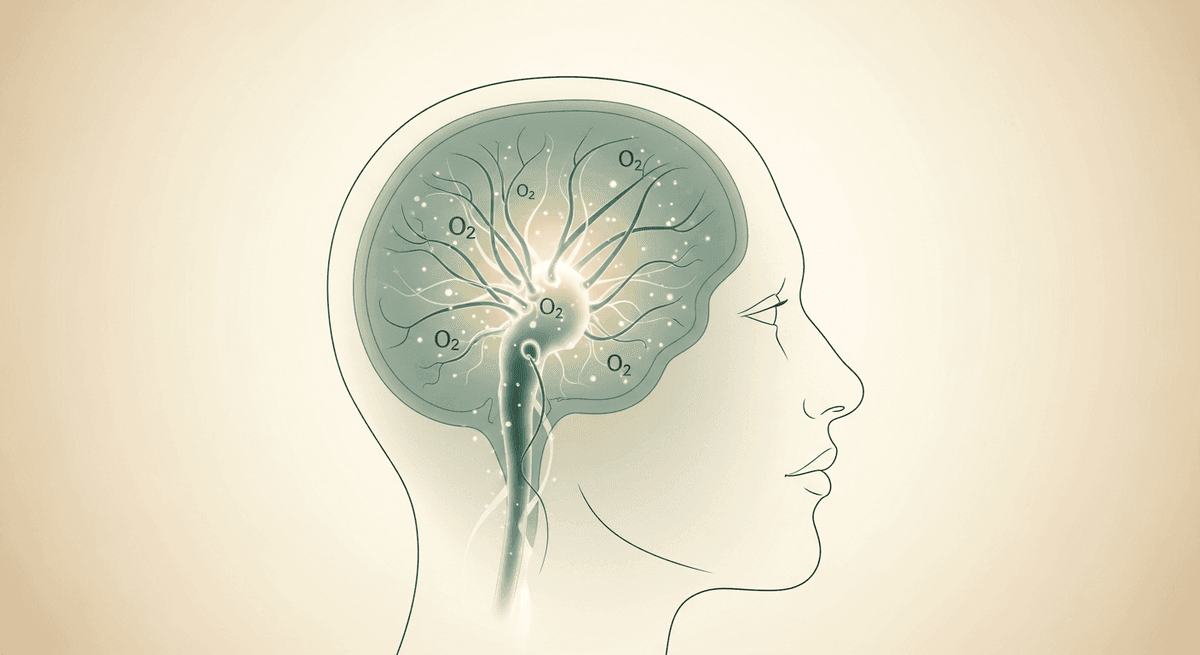
HBOT involves breathing concentrated oxygen inside a pressurised chamber. At mild pressures — typically 1.3 to 1.5 ATA (atmospheres absolute) — the amount of dissolved oxygen in the bloodstream increases substantially. Unlike the oxygen carried by red blood cells, this dissolved oxygen can reach areas where circulation may be compromised, including inflamed or damaged brain tissue.
The brain is uniquely dependent on oxygen. It accounts for roughly 20% of the body's total oxygen consumption despite representing only about 2% of body weight. When brain tissue is injured, inflamed, or starved of adequate blood flow, even small improvements in oxygen availability may have meaningful physiological effects.
The proposed mechanisms include: reversal of neuroinflammation, stimulation of new blood vessel growth (angiogenesis) in damaged areas, upregulation of brain-derived neurotrophic factor (BDNF — a protein involved in neuronal repair and growth), and improved mitochondrial function in neurons.
These aren't theoretical claims. They're the biological rationale behind a growing volume of clinical trials — several of which are directly relevant to mild HBOT at 1.5 ATA.
What the Research Shows: Key Evidence Areas
Brain Injury and Post-Concussion Syndrome
One of the most significant recent developments in this field is a 2025 double-blind, sham-controlled randomised trial published in Nature Scientific Reports. The study examined the effects of 40 sessions of HBOT at 1.5 ATA in people with traumatic brain injury (TBI).
The results were clinically meaningful. The HBOT group showed substantially greater improvement in neurobehavioural symptoms compared to the sham group — with measurable gains continuing beyond the initial 40 sessions when further unblinded treatment was provided.
Critically, this trial was conducted specifically at 1.5 ATA — the mild pressure range relevant to the kind of HBOT available in integrative wellbeing settings. The sham-controlled design also rules out placebo effect as the primary explanation for the outcomes.
For people dealing with post-concussion symptoms — including persistent headaches, cognitive slowing, sleep disruption, and irritability — this evidence is worth understanding.
PTSD and Treatment-Resistant Mental Health
A 2024 systematic review published in Frontiers in Neurology examined seven randomised trials investigating HBOT as a support for PTSD. The findings were striking: statistically significant improvement in PTSD symptoms was reported across nearly all treatment groups included in the review.
What makes this particularly notable is that the improvements were seen even in cases of treatment-resistant PTSD — including people who had been living with symptoms for more than ten years. Three of the included studies corroborated their outcomes with functional or anatomical brain imaging, providing an objective marker alongside symptom-reported changes.
The dosage analysis within the review is also relevant. Lower-to-moderate pressures — consistent with 1.5 ATA — were associated with better outcomes than the highest pressures tested. This supports the biological plausibility of mild HBOT as an adjunct in this context.
It is important to be clear: HBOT is not a replacement for psychological therapy, medication review, or specialist mental health support. If you are living with PTSD or complex mental health challenges, any adjunct approach should be discussed with your existing care team. What the evidence suggests is that, within a structured wellbeing plan, HBOT may offer an additional layer of support.
Stroke Recovery
The brain has a remarkable, if underappreciated, capacity for recovery — even years after a stroke. This is the foundation of the neuroplasticity hypothesis that underlies much of the HBOT research in stroke rehabilitation.
A well-regarded randomised controlled trial published in PLoS ONE demonstrated measurable improvements in neurological function, activities of daily living, and quality of life in chronic stroke patients who underwent a course of HBOT. Notably, SPECT imaging — which measures brain blood flow — confirmed that the clinical improvements corresponded with actual changes in tissue perfusion in areas surrounding the original stroke site.
A further study from the Sagol Center in Israel found that a substantial majority of participants showed clinically significant cognitive improvement following a course of HBOT sessions. The implications of late-stage neuroplasticity — the idea that dormant but intact neurons can be re-activated through adequate oxygenation — are significant for those many months or years beyond their initial stroke event.
Acute ischaemic stroke (the immediate window following a stroke) is not an appropriate context for HBOT, and this article is not suggesting otherwise. The evidence here relates specifically to chronic stroke rehabilitation, typically six or more months post-event. Anyone in this position should discuss any adjunct approaches with their neurologist or GP.
What HBOT Can and Cannot Offer for Brain Health
It's important to be honest about scope. HBOT is not a treatment for neurological conditions, and it should not be positioned as one. Here is a clear summary of what the evidence suggests and what it does not support:
| HBOT may support | HBOT is not |
|---|---|
| Oxygen availability to brain tissue | A cure for neurological conditions |
| Neuroinflammation modulation | A replacement for specialist medical care |
| Post-concussion symptom management (as adjunct) | A diagnostic tool |
| Recovery alongside PTSD therapy | A standalone mental health intervention |
| Neuroplasticity support in chronic stroke rehab | Appropriate for acute or emergency neurological events |
| Brain fog and cognitive fatigue (as part of a wider plan) | Suitable for everyone — individual assessment is essential |
How Does This Fit Into a Wellbeing Plan?
At Rebalance Wellbeing Hub CIC, HBOT is never offered as a quick fix or a standalone intervention. It is one component of a personalised wellbeing approach that considers sleep, nutrition, stress, movement, and mental health alongside any adjunct therapies.
The pathway begins with a free HolistIQ wellbeing assessment — a 40-minute online tool that scores your wellbeing across eight systems, including energy, sleep, stress, and cognitive patterns. From there, a conversation with one of our practitioners explores your goals and builds a roadmap that may or may not include therapies like HBOT, depending on your individual picture.
Therapies are never prescribed in isolation. They are integrated into a broader plan — and if your situation suggests you need specialist neurological or mental health assessment first, we will tell you that clearly and signpost you accordingly.
Frequently Asked Questions
Is HBOT safe for brain-related conditions?
At mild pressures (1.3–1.5 ATA), HBOT has a well-documented safety profile in clinical trials. Side effects — including mild ear pressure during pressurisation — are generally minor and temporary. That said, individual suitability varies, and a proper wellbeing assessment is the starting point before any therapy.
How many sessions are typically needed?
Most of the clinical trials showing meaningful neurological outcomes used courses of 40 sessions. However, individual responses vary and the right approach depends on your starting point, goals, and overall wellbeing picture. This is something we can talk through when you get in touch.
Can HBOT replace my medication or therapy for PTSD or brain injury?
No. HBOT is an adjunct — it works alongside, not instead of, existing care. If you are under the care of a psychiatrist, neurologist, or GP, any wellbeing additions should be discussed with them.
Do I need a referral to try HBOT at Rebalance?
No referral is needed. The starting point is our free HolistIQ assessment, followed by a conversation with our team to determine whether HBOT is appropriate as part of your individual plan.
Is the research on HBOT and the brain robust enough to take seriously?
The 2025 Nature Scientific Reports trial and the 2024 Frontiers in Neurology PTSD systematic review represent a meaningful step forward in clinical evidence quality. The research is not yet at the level of established medical protocol for most neurological conditions — but it is substantive enough to take seriously as part of an evidence-informed adjunct approach.
The Next Step
If you're living with brain fog, cognitive fatigue, post-concussion symptoms, or the lasting effects of a traumatic or neurological event, the best starting point is understanding your full wellbeing picture — not jumping straight to a therapy.
Our free HolistIQ assessment takes around 40 minutes and scores your energy, sleep, stress, gut health, and cognitive patterns across eight wellbeing systems. It's a genuine starting point, not a sales funnel.
Start your free HolistIQ assessment: holistiq.healthandwellbeinghub.uk
When you're ready to go deeper, get in touch and we'll build a plan that makes sense for where you actually are.
Get in touch: healthandwellbeinghub.uk/contact
References
'A double-blind randomized trial of hyperbaric oxygen for persistent symptoms after brain injury', Scientific Reports (2025).
'Systematic review and dosage analysis: hyperbaric oxygen therapy efficacy in the treatment of posttraumatic stress disorder', Frontiers in Neurology (2024).
Efrati, S. et al. (2013) 'Hyperbaric oxygen induces late neuroplasticity in post stroke patients — randomized, prospective trial', PLoS ONE, 8(1), e53716.
Hadanny, A. et al. (2020) 'Hyperbaric oxygen therapy improves neurocognitive functions of post-stroke patients — a retrospective analysis', Restorative Neurology and Neuroscience, 38(1), pp. 93–107.
Rebalance Wellbeing Hub CIC provides wellbeing consultations and lifestyle coaching. We do not diagnose medical conditions or provide emergency care. If you have concerns that may need medical assessment, please speak with your GP or call 111. HBOT at Rebalance is offered as an adjunct therapy within a structured wellbeing pathway, not as a standalone medical treatment.
Subscribe to the blog
Get an email when we publish new articles on functional medicine, holistic therapies, and community wellbeing.
Prefer a feed reader? Subscribe via RSS